The ACM Turing Award Lectures

is an excellent book (isbn 0-201-54885-2). As usual I'm going to quote from a few pages:
The effective exploitation of his powers of abstraction must be regarded as one of the most vital activities of a competent programmer. [Edsger Dijkstra]
If we go back to Latin roots, we find ars, artis meaning "skill." It is perhaps significant that the corresponding Greek word was Τέχνη, the root of both "technology" and "technique". [Donald Knuth]
The assignment statement is the von Neumann bottleneck of programming languages. [John Backus]
I find a certain technique most helpful in expanding my own capabilities. After solving a challenging problem, I solve it again from scratch, retracing only the insight of the earlier solution. I repeat this until the solution is as clear and direct as I can hope for. Then I look for a general rule for attacking similar problems in the most efficient way the first time. Often, such a rule is of permanent value…
To sum up, my message to the serious programmer is: spend a part of your working day examining and refining your own methods. [Robert Floyd]
I conclude that there are two ways of constructing a software design: One way is to make it so simple that there are obviously no deficiencies and the other way is to make it so complicated that there are no obvious deficiencies. [C.A.R. Hoare]
UNIX is a simple coherent system that pushes a few good ideas and models to the limit. [Dennis Ritchie] I am a programmer. I write programs. [Ken Thompson]
To parody our current methods of teaching programming, we give beginners a grammar and a dictionary and tell them that they are now great writers. We seldom, if ever, given them any serious training in style… Like writing, programming is a difficult and complex art. [R.W. Hamming]
There are many ways to formulate things and it is risky to become too attached to one particular form or law and come to believe that it is the real basic principle. [Marvin Minsky]
To state a problem is to designate (1) a test for a class of symbol structures (solutions of the problem), and (2) a generator of symbol structures (potential solutions). To solve a problem is to generate a structure, using (2), that satisfies the test of (1). [Allen Newell and Herbert Simon]
The utility of a language as a tool of thought increases with the range of topics it can treat, but decreases with the amount of vocabulary and the complexity of grammatical rules which the user must keep in mind. Economy of notation is therefore important. [Kenneth Iverson]

Augustine's Laws

is an excellent book by Norman Augustine (isbn 0-670-80942-X). As usual I'm going to quote from a few pages.

First the serious quotes:
To finish first you must first finish.
Little did the Greeks know - the universe actually consists of Earth, fire, water, and software.
The budgeting process resists change.
If you want it bad you get it bad.
We can overcome gravity, but sometimes the paperwork is overwhelming. [Wernher von Braun]
The objective in business, however, is to measure how many undertakings are completed - not how many can be started.
reliability… must be designed into the product by the designer and built into it by the manufacturer - it cannot be inculcated by the quality department.
…the parts which break… are always the ones located in the most inaccessible places. Therefore, only a few mechanics are able to crowd around them simultaneously.
Managers must have the discipline not to keep pulling up the flowers to see if their roots are healthy [Robert Townsend]
and second the funny quotes:
Anybody can have an off decade.
...turned out to be the earliest they had ever been late.
Our team is well balanced - we have problems everywhere.
…trying to leap deep chasms in two bounds.
If it weren't for bad luck he'd have no luck at all.
It's like sending lettuce by rabbit.
There was good news and there was bad news. The good news was that management was buying everyone on the assembly line a turkey for Christmas. The bad news was that they had only ordered ten turkeys.
A knife without a blade, for which the handle is missing. [Lichtenberg]
Lord Barnetson, chairman of the London Observer, has had attributed to him the following anecdote about how a management critic would review Schubert's Unfinished Symphony:
  • It appears that for a considerable period of time the four oboe players had nothing to do. The number should be reduced, and their work spread over the whole orchestra...
  • All twelve violins were playing identical notes. This seems unnecessary duplication and the staff of the section should be drastically cut...
  • Much effort was absorbed in the playing of demisemi-quavers. This seems an excessive refinement, and it is recommended that all notes be rounded up to the nearest semiquaver...
  • No useful purpose is served by repeating with horns the passage that had already been handled by the strings...

The Options Trap

one option is a trap,
two options is a dilemma,
three options is a choice.


I recall Jerry Weinberg saying this (or something very similar) during either an AYE conference or his Problem Solving Leadership course. I'm think I've also read it in one of Jerry's books, or was it Virginia Satir, but despite a reasonably thorough search I can't put my finger on it. (If you can locate the source in one of his books I'd appreciate an email).

I think software developers are prone to falling into options traps. If someone presents me with a choice between A and B I can easily be unknowingly coerced into thinking the only choices are A or B. And of course that's not true. I can choose A and B. Or maybe C. Or D. Or maybe make no choice at all. And of course, I often fall into the trap when presenting the options myself.

I was reminded of the options trap when watching The Princess Bride with my son Patrick the other day. There is a superb scene where the Man in Black arranges a battle of wits (to the death) with Vizzini. He shows Vizzini some iocane powder (iocane is odourless, tasteless, dissolves instantly in liquid, and is among the more deadly poisons known to man - in other words it's invisible just like software is, well except for the dissolving in liquid bit). But I digress. The Man in Black takes two goblets of wine and a full packet of iocane powder and turns his back on Vizinni. A moment later, he turns to face Vizzini again and the packet of iocane powder is empty. He says to Vizzini

All right: where is the poison? The battle of wits has begun. It ends when you decide and we both drink, and find out who is right and who is dead.


The Man in Black never explicitly says it (the wording is very precise), but Vizzini is unknowingly led (and so are you when you watch the film the first time) to believe that there are only two options; either the iocane powder is in Vizzini's goblet of wine, or the iocane powder is in the Man in Black's goblet of wine. If you've watched the film you know that there is a third option. I won't spoil the scene for you by telling you what the third option is - if you want to know I suggest googling Mithridates VI of Pontus. Or watching the film!

Through the language glass

is an excellent book edited by Guy Deutscher (isbn 978-0-8050-8195-4). As usual I'm going to quote from a few pages:
In the meantime, The Origin of Species had appeared and Darwinism had conquered the collective psyche. As George Bernard Shaw later wrote, "Everyone who had a mind to change changed it."
The Lamarckian nature of Magnus's model now emerged as just one of the gaping holes in his Emmental of a theory.
People find names for the things they feel the need to talk about.
In a large society of strangers there will be many more occasions where elaborate information has to be conveyed without reliance on shared background and knowledge.
"What fetters the mind and benumbs the spirit… the dogged acceptance of absolutes." [Edward Sapir]
Languages differ essentially in what they must convey and not in what they may convey.
The Matses… have to be master epistemologists. There are separate verbal forms depending on whether you are reporting direct experience (you saw someone passing by with your own eyes), something inferred from evidence (you saw footprints on the sand), conjecture (people always pass by at that time of day), or hearsay (your neighbour told you he had seen someone passing by).
Guugu Yimithirr… does not make any use of egocentric coordinates [eg left, right] at all! … Whenever we would use the egocentric system, the Guugu Yimithirr use the four cardinal directions: gungga (North), jiba (South), guwa (West), and naga (East. … They maintain their orientation with respect to the fixed cardinal directions at all times. Regardless of visibility conditions, regardless of whether they are in a thick forest or on an open plain, whether indoors or outside, whether stationary or moving, they have a spot-on sense of direction.
John Haviland estimates that as many as one word in ten (!) in a normal Guugu Yimithirr conversation is north, south, west, or east, often accompanied by very precise hand gestures. … Everyday communication in Guuga Yimithirr provides the most intense drilling in geographic orientation from the earliest imaginable age.
The conventional predictions are that within two or three generations at least half the world's six thousand languages will have disappeared.
Each step in this chain was natural and made perfect sense in its own local context. But the end result seems entirely arbitrary.
The worst thing about this loss of transparency is that it is a self propelling process: the less consistent the system becomes, the easier it is to mess it up even further.
Until the eleventh century, English had a full-blown three-gender system just like German.

The Autobiography of Martin Luther King, Jr

is an excellent book edited by Clayborne Carson (isbn 978-0-349-11298-5). As usual I'm going to quote from a few pages:
I became convinced that noncooperation with evil is as much a moral obligation as is cooperation with good.
Capitalism is always in danger of inspiring men to be more concerned with making a living than making a life.
Gandhi resisted evil eight as much vigour and power as the violent resister, but he resisted with love instead of hate.
We'd better decide now if we are going to be fearless men or scared boys.
I realised that this speech had evoked more response than any speech or sermon I had ever delivered, and yet it was virtually unprepared. I came to see for the first time what the older preachers meant when they said, "Open your mouth and God will speak for you."
We came to see that, in the long run, it is more honourable to walk in dignity than ride in humiliation.
Gandhi was able to mobilise and galvanise more people in his lifetime than any other person in the history of this world.
A tender heart and a tough mind.
Justice too long delayed is justice denied.
A social movement that only moves people is merely a revolt. A movement that changes both people and institutions is a revolution.
It is a climate where men cannot disagree without being disagreeable.
The ultimate test of a man is not where he stands in moments of comfort and moments of convenience, but where he stands in moments of challenge and moments of controversy.
Accordingly, each situation has to be studied in detail;… Nevertheless, we had to begin a march without knowing when or where it would actually terminate.
I refuse to determine what is right by taking a Gallop poll of the trends of the time… Ultimately a genuine leader is not a searcher for consensus but a molder of consensus.

Not agile

My friend Olve Maudal from Tandberg (now part of Cisco) gave me this fridge magnet. The caption reads "Unfortunately, by the time Rupert's mother had finished knitting his outfit, the war was over." I love it. Thanks Olve.

Washroom soap visibility

My tongue-in-cheek blog on washroom taps is one of my favourites. I recently ran into the pictured soap-refuser. It was firmly fixed to the wall and was completely empty. (I particularly love the keyhole on top. I never knew soap was so prone to being stolen!) The unit was opaque white so I had no clue it was empty. I pressed the tiny nozzle at the bottom and all I got was an even tinier stream of air. Away from the wall, and right next to the taps there were some green-soap dispensers. They were green because the soap they contained was green. I could clearly see one was almost empty and one was almost full.

Mens-room 404

Last week I taught SkillsMatter's 3 day agile course written by Kevlin Henney. I've run this a few times now and each time seems to get better. I'm more and more impressed by SkillsMatter as a company. Nothing is too much trouble. And they have a great sense of humour - as the notice on the left shows!

Pinesoft cyber-dojo

I ran a cyber-dojo at the Agile Cambridge conference recently. One of the participants, Alex Graff, decided to run a cyber-dojo at his place of work, Pinesoft in central London. Nine players participated and their comments on the session included: "really good", and "a lot of fun".

Alex ran the session broadly as I did in Cambridge, as a metaphor:
  • the kata on each computer represents a feature for a product, with the product being the sum of all those features
  • the tests for each computer (which are visible to all computers) use a simple traffic light display, green light if all tests pass, red light if some tests are failing, yellow light is the tests can't be run (eg syntax error)
  • if everyone's tests pass all the lights will be green which represents a stable releasable build
  • if any computer's light is not green, the build is broken and can't be released to the client
Periodically Alex called for a release which was the cue for everyone to work towards simultaneous green lights. This took a long time the first time (as it always does) but the players quickly increased their collaboration (the game's prime directive) to work collectively towards a faster release.

Alex cleverly arranged a pair of developers at each computer - except for one. This gave all the participants experience of working in pairs most of the time but also having the occasional period of working alone. During the retrospective he asked how players felt when not in a pair. Responses included "totally different", "isolated", "felt lonely" and "the worst thing was not having someone to discuss with". The single-person laptop was also located some way off to the side, away from the other laptops which usefully served to enhance the difference.

Alex also reports that one of the highlights (and aims) of his session was getting all our developers working together.
Thank you Alex.

One month next Wednesday

I was speaking to Andy Longshaw at the SkillsMatter Agile and Lean eXChange conference. He told me a great story. There are two guys at a train station in India. It's hot and they're having a cold beer. The train pulls into the station. In no time at all its absolutely jam packed with people. Despite being "full" people continue to get on. People hang onto the side. People hang onto the front! People climb onto the roof! The guys decide to have one more cold beer. They miss the train. They ask a guard "when is the next train" and the guard replies "one month next Wednesday!"

There is a wonderful underlying dynamic to this story. It's because there is only one train a month that it's so overcrowded. If the train ran more frequently it wouldn't be so full because passengers would know it ran more frequently. Perhaps in the past there were two trains and they ran twice as often. But maybe one broke down and for whatever reason never got fixed. So now there is just one a month. And every time it runs it's dangerously overloaded. Because it's overloaded it's more likely to break down...

If you release every 12 months and a feature doesn't make it into the next release you'll have to wait at least another whole year for it. So there's pressure to add loads of features into the next release. And everyone knows that 12 months is optimistic anyway. So there's even more pressure to add even more features into the next release. The release train gets full. And the more overloaded it gets the more likely it is to slip. And the more it slips the greater the pressure to add more features into the next release...

Mindset

is an excellent book edited by Carol Dweck (isbn 978-0-345-47232-8). As usual I'm going to quote from a few pages:
It's startling to see the degree to which people with the fixed mindset do not believe in effort.
We found that people greatly misestimated their performance and their ability. But it was those with the fixed mindset who accounted for almost all the inaccuracy. The people with the growth mindset were amazingly accurate.
The best pilots fly more than the others; that's why they're the best.
John Wooden, the legendary basketball coach says that you aren't a failure until you start to blame.
Was it Mozart's musical ability or the fact that he worked till his hands were deformed?
A growth mindset helps people to see prejudice for what it is - someone else's view of them.
Babe Ruth loved to practice. In fact when he joined the Boston Red Sox… he wasn't just a rookie. He was a rookie pitcher.
Character grows out of mindset.
Too many bosses are driven and driving but going nowhere.
Tout comprendre c'est tout pardonner - to understand all is to forgive all.
Speed and difficulty are the enemy of learning.
Success is not coming to you, you must come to it.

Thinking in systems - a primer

is an excellent book edited by Donella Meadows (isbn 978-1-84407-726-7). As usual I'm going to quote from a few pages:
The system, to a large extent, causes its own behaviour.
If you see a behaviour that persists over time, there is likely to be a mechanism creating that consistent behaviour.
Economies are extremely complex systems; they are full of balancing feedback loops with delays and they are inherently oscillatory.
This capacity of a system to make its own structure more complex is called self-organization.
Complex systems can evolve from simple systems only if there are stable intermediate forms.
In hierarchical systems, relationships within each subsystem are denser and stronger than relationships between subsystems.
Hierarchical systems evolve from the bottom up.
Systems fool us by presenting themselves… as a series of events…
Side-effects. This phrase means roughly "effects which I hadn't foreseen or don't want to think about."
Everything is connected to everything else - and not neatly.
We have to invent boundaries for clarity and sanity; and boundaries can produce problems when we forget that we've artificially created them.
Economics evolved in a time when labour and capital were the most common limiting factors to production. Therefore economies keep track only of these two factors.
Much of the action you were trying to correct was in response to your own action.
Before you disturb the system in any way, watch how it behaves.
Everything everyone knows is a model.

kanban 1's game

NB: Heres a more recent slide-deck

I ran my Kanban 1's Game as an open space session at both the xpday conference and also at the Lean, Agile eXchange conference. It proved quite popular so here is how to play it if you're interested. Kanban1sGameRules

Some notes on new game variations/updates

Thank you to Kevlin Henney and Liz Keogh who helped to improve the game.

Agile, Lean and Kanban eXchange cyber-dojo

Thank you to SkillsMatter for hosting the Agile, Lean and Kanban eXchange conference. It was a great event. And thank you to the ten or so people who participated. I got some great feedback and plan to make some tweaks to cyber-dojo, particularly giving the players the ability to control the rotation period in their dojo. It will be interesting to see what value future players will set the rotation period to when they have a free choice.
I also introduced a very simple mini kanban display for each laptop; three pieces of paper marked red (in red), green (in green), and refactor (in black). You then move your avatar badge (eg wolves) onto one of the pieces of paper to reflect your current intention.

A little book of f-LAWS

is an excellent book edited by Russell Ackoff and Herbert Addison (isbn 0-9550081-1-5). As usual I'm going to quote from a few pages:
The best organisations aim to remove the expectation of compliance and eliminate the fear of getting things wrong.
Doing something right can only confirm what one already knows or believes; one cannot learn from it. However, one can learn from making mistakes, by identifying and correcting them.
Organizations fail more often because of what they have not done than because of what they have done.
The opportunity for real and useful learning comes in the face of adversity.
The people who achieve real mastery at something know what it is that makes them so good.
The best managers are genuinely interested in finding out what other people think and have superb listening skills.
Consumer involvement in product/service design almost always gets creative results.

More C macro magic - CASES

I was thinking about the PP_NARG macro this morning. It occurred to me that you could use it to create a macro for a range of case labels in a switch statement! Instead of writing this:
void eg(int n)
{
    switch(n)
    {
        case 1:
        case 2:
        case 3:
        case 4:
        case 5:
            printf("1..5\n"); 
            break;
    }
}
You could write this:
void eg(int n)
{
    switch(n)
    {
        CASES(1,2,3,4,5):
            printf("1..5\n"); 
            break;
    }
}
and the C99 magic macro is:
#define PP_NARG(...) \
    PP_NARG_(__VA_ARGS__, PP_RSEQ_N())

#define PP_NARG_(...) \
    PP_ARG_N(__VA_ARGS__)

#define PP_ARG_N(_1, _2, _3, _4, _5, _6, N, ...)   N

#define PP_RSEQ_N() \
    6,5,4,3,2,1,0

#define CASES(...) \
    CASES_(PP_NARG(__VA_ARGS__), __VA_ARGS__)

#define CASES_(N,...) \
    CASES_N(N,__VA_ARGS__)

#define CASES_N(N,...) \
    CASES_ ## N(__VA_ARGS__)

#define CASES_1(a)     case a
#define CASES_2(a,...) case a: CASES_1(__VA_ARGS__)
#define CASES_3(a,...) case a: CASES_2(__VA_ARGS__)
#define CASES_4(a,...) case a: CASES_3(__VA_ARGS__)
#define CASES_5(a,...) case a: CASES_4(__VA_ARGS__)


Weinberg on writing

is an excellent book edited by Jerry Weinberg (isbn 0-932633-65-X). As usual I'm going to quote from a few pages:
Writer's block is not a disorder in you, the writer. It's a deficiency in your writing methods - the mythology you've swallowed about how works get written - what my friend and sometime coauthor Tom Gilb called your "mythology".
It's not the number of ideas that blocks you, it's your reaction to the number of ideas.
A trigger is a small amount of input energy that sets off a large amount of output energy.
"You know, there would be no problem raising kids if only you could throw away the first one."
The essence of the Fieldstone Method is to gather great quantities of words and then to discard a slightly less great quantity.
Learning, it seems, is a matter of repeated attempts, until one finds a teacher, a book, a film, an approach, a flash, or something that finally gets the point across.
About one third of the time, the problem turns out to be that the passage didn't mean anything, or meant several things at once.
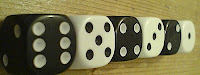
Mozart used dice to produce ideas for musical themes, and even designed a dice game for composing new minuets.
Often, in the middle of a game, an idea will pop into my mind, and I will immediately pop it into the window I have open for the manuscript. Sometimes, I continue writing from that idea for hours. When I finish, I'm generally surprised to find a half-finished solitaire game in progress.

C macro magic - PP_NARG

I've just spent two days delivering my C Foundation course to the massively talented people at Cisco (nee Tandberg nee Codian) in Langley. One of the guys on the course called Alex showed me an amazing C99 macro that counts the number of parameters. The capacity of C to surprise me with something new never ceases to amaze. Here it is (cut down to handle just 6 parameters to save space):
#include <stdio.h>

#define PP_NARG(...) \
    PP_NARG_(__VA_ARGS__, PP_RSEQ_N())

#define PP_NARG_(...) \
    PP_ARG_N(__VA_ARGS__)

#define PP_ARG_N( \
    _1, _2, _3, _4, _5, _6, N, ...)   (N)

#define PP_RSEQ_N() \
    6,5,4,3,2,1,0

int main(void)
{
    printf("%d\n", PP_NARG(a,b+c+d)); // 2
    printf("%d\n", PP_NARG(a,b,c,d,e+f)); // 5
    return 0;
}
Alex mentioned it doesn't work for zero parameters - it incorrectly returns one. Of course I can't resist seeing if I can fix that. After playing around a bit I've come up with this which seems to work.
#define PP_NARG(...) \
    PP_NARG_(sizeof #__VA_ARGS__, __VA_ARGS__, PP_RSEQ_N())

#define PP_NARG_(delta, ...) \
    PP_ARG_N(delta, __VA_ARGS__)

#define PP_ARG_N( \
    delta, _1, _2, _3, _4, _5, _6, N, ...)   (N - ((delta)==1))

#define PP_RSEQ_N() \
    6,5,4,3,2,1,0
Alex joked that at parties he's tried to impress girls with this macro. Of course he increases the number of parameters to 128. Size matters after all. And naturally he boasts not only of the macro's size but also of it capacity for expansion!

Beating the system

is an excellent book edited by Russell Ackoff and Sheldon Rovin (isbn 1-57675-330-1). As usual I'm going to quote from a few pages:
Beating the system can be a serious and occasionally risky business; some courage is needed.
Bureaucrats are usually empowered to say no to even reasonable requests, but they cannot say yes to them. This requires passing requests to a higher authority. Saying no inflates bureaucrats' self-images.
Nothing beats knowing how the system you're trying to beat actually works because the chances are that no one else knows, with the possible exception of secretaries.
We do not try to cure headache by perfuming brain surgery. Rather, we put a pill in our stomach.
The usual way of doing things often gets in the way of doing things.
Time is our only absolutely nonrenewable and, thus, most highly valued resource. To place a low value on another's time is to show a lack of respect for that person.
Persistence is a fundamental attribute of a system beater.
In most workplaces explicit and implicit assumptions often constrain behaviour.
Implicit assumptions lead to behaviours that are carried out automatically, without thought, and these behaviours constitute an organisation's or a society's culture. Culture is what we do when we do not consciously decide what to do.
Most assumptions made in and about organisations usually go unquestioned, and their validity is taken to be self-evident, despite Ambrose Bierce's (1967,289) admonition that "self-evident" means evident to oneself and no one else. "Obvious" does not mean "requiring no proof" but "no proof is desired."
No particular virtue exists in doing things the way they've always been done and in thinking about things in the way they've always been thought about.
Undesirable customs persist because they are tolerated without thought.
Effective police officers think like criminals; effective criminals think like police officers.
The major obstructions between a person and what he or she wants is not "out there" but in the person's mind.
A problem tends to be placed into the discipline of the one who first identifies it.
Problems are not defined by disciplines, although disciplinarians think so.

Sclumberger Japan


I visited Japan for the first time recently. I taught an Object Oriented Analysis and Design course for Schlumberger at Machida. The software metier there is a lovely man called Shin'ichi Watanabe who made me feel very welcome. He took me to a proper Japanese restaurant (which seated at most about 8 people) where you had to take your shoes off. The food was delicious as was the saki.