Showing posts with label congruence. Show all posts

the power of example

Last week I attended another excellent Jerry Weinberg course in Albuquerque. Here's one of the nuggets I learned. It's related to the famous Solomon Asch social psychology conformity experiment.

In the experiment a group of people are shown two cards. The first card has a single line on it. The second card has three lines on it labelled A,B,C one of which clearly matches the length of the line on the other card (and the other two clearly don't). Only one person in the group is the actual subject and is unaware that the other members of the group are part of the experiment. The experiment measures how likely the subject is to conform to the answer given by everyone else when that answer is clearly the wrong one. The answer is "quite a lot". But that's not what I learned. What I learned about is a variation on that experiment. One where Solomon Asch measured how the effect varied depending on how many other people's answers matched, or didn't match, the subject's answer. You can read about this variation (and some others) here. This is the punchline:

The presence of a [single] supporting partner depleted the majority of much of its power. Its pressure on the dissenting individual was reduced to one fourth: that is, subjects answered incorrectly only one fourth as often as under the pressure of a unanimous majority.

Isn't that a great example of the power of setting an example. Of how change happens one person at a time. Of courage. Of how important it is that people feel safe. People are always more impressed by the power of our example than by the example of our power.


more secrets of consulting

is an excellent book by Jerry Weinberg (isbn 978-0932633521). As usual I'm going to quote from a few pages:
Consultants are hired for knowing what others don't know, so a consultant who stops learning soon decays in value.
It's always better to be a do-something rather than a know-everything.
The Wishing Wand reminds me of the ability to ask for what I want, and if necessary, to live with not getting it.
Modern psychology often scorns introspection and has become the study of other people's behaviour.
I personally think that big changes result from an accumulation of small changes.
Incongruence is stereotyped behaviour.
It takes big balance to learn small balance.
Nothing is immutably programmined into my mind - except its programmability. The ability of my mind to program itself is a far greater ability than any particular program.
Fear is one of the brakes on creativity.
In social engineering, as in all engineering, failures teach more than successes.

surely you're joking Mr Feynman

subtitled 'Adventures of a Curious Character', is an excellent book by Richard Feynman (isbn 978-0-099-17331-1). As usual I'm going to quote from a few pages:
Radio sets were much easier to understand in those days because everything was out in the open. After you took the set apart (it was a big problem to find the right screws), you could see this was a resistor, that's a condenser, here's a this, there's a that; they were all labelled.
I finally fixed it beause I had, and still have, persistence.
They didn't even know what they "knew". I don't know what's the matter with people: they don't learn by understanding; they learn by some other way - by rote, or something. Their knowledge is so fragile.
In this room there were wires strung all over the place! Switches were hanging from the wires, cooling water was dripping from the valves, the room was full of stuff, all out in the open. Tables piled with tools were everywhere; it was the most godawful mess you ever saw. The whole cyclotron was there in one room, and it was complete, absolute chaos!
It reminded me of my lab at home. Nothing at MIT had ever reminded me of my lab at home. I suddenly realized why Princeton was getting results. They were working with the instrument. They built the instrument; they knew where everything was, they knew how everything worked. ... It was wonderful! Because they worked with it. They didn't have to sit in another room and push buttons.
I sat with the physicsts, but after a bit I thought: It would be nice to see what the rest of the world is doing, so I'll sit for a week or two in each of the other groups.
So you must be always jiggling a little bit, testing out which way seems to be the easiest.
One day I was watching a paramecium and I saw something that was not described in the books I got in school - in college, even. These books always simplify things so the world will be more like they want it to be.
I chose to play a thing called a "frigideira" which is a toy frying pan made of metal, about six inches in diameter, with a little metal stick to beat it with. ... I practiced all the time. I'd walk along the beach holding two sticks that I had picked up, getting the twisty motion of the wrists, practicing, practicing, practicing.
One day, shortly before Carnival time, the leader of the samba school said, "OK, we're going to practice marching in the street. ...
It was rush hour in Copacabana, and we were going to march down the middle of Avenida Atlantica.
It said to myself, "Jesus! The boss didn't get a license, he didn't OK it with the police, he didn't do anything. He's decided we're just going to go out."
So we started to go out into the street, and everybody, all around, was excited. Some volunteers from a group of bystanders took a rope and formed a big square around our band, so the pedestrians wouldn't walk through the lines. People started to lean out of the windows. Everybody wanted to hear the new samba music. It was very exciting!
As soon as we started to march, I saw a policeman, way down at the other end of the road. He looked, saw what was happening, and started diverting traffic! Everything was informal. Nobody made any arrangements, but it all worked fine.
One exercise they had invented for loosening us up was to draw without looking at the paper. Don't take your eyes off the model; just look at her and makes the lines on the paper without looking at what you're doing.
One of the guys says, "I can't help it. I have to cheat. I bet everybody's cheating!"
"I'm not cheating!" I say.
"Aw, baloney!" they say.
I finish the exercise and they come over to look at what I had drawn. They found that, indeed, I was NOT cheating; at the very beginning my pencil point had busted, and there was nothing but impressions on the paper.
When I finally got my pencil to work, I tried again. I found that my drawing had a kind of strength - a funny, semi-Picasso-like strength - which appealed to me. The reason I felt good about that drawing was, I knew it was impossible to draw well that way, and therefore it didn't have to be good - and that's really what all the loosening up was all about. I had thought that "loosen up" meant "make sloppy drawings," but it really meant to relax and not worry about how the drawing is going to come out.
When it came time to evaluate the conference at the end, the others told how much they got out of it, how successful it was, and so on. When they asked me, I said, "This conference was worse than a Rorschach test: There's a meaningless inkblot, and the others ask you what you think you see, but when you tell them, they start arguing with you!


the silent language

is an excellent book by Edward T. Hall (isbn 0-385-05549-8). As usual I'm going to quote from a few pages:
Culture hides much more than it reveals, and strangely enough what it hides, it hides most effectively from its own participants.
Interaction has its basis in the underlying irritability of all living substance.
Culture is saturated with both emotion and intelligence.
Theodosius Dobzhansky, the great human geneticist, once observed that life was the result of neither design nor chance but the dynamic interaction of living substance with itself. He meant that life, in a changing environment, places such strains on the organism to adapt that, if this does not take place constantly, the organism as a species dies out.

Different cultures are analogous to different species in the sense that some of them survive whilst others perish. Some are more adaptive than others. The study of change, therefore, is the study of survival.
An often noted characteristic of culture change is that an idea or a practice will hold on very persistently, apparently resisting all efforts to move it, and then, suddenly, without notice, it will collapse.
The idea of looking at culture as communication has been profitable in that it has raised problems which had not been thought of before and provided solutions which might not otherwise have been possible.
We say, "I'll see you in an hour." The Arab says, "What do you mean, 'in an hour'? Is the hour like a room, that you can go in an out of it?" To him his own system makes sense: "I'll see you before one hour," or "I'll see you after one week." We go out in in the rain. The Arab goes under the rain.
...we all hold an illusion about talking, an illusion that talking is quite untrammeled and spontaneous and merely 'expresses' whatever we wish to have it express. This illusory appearance results from the fact that the obligatory phenomena within apparently free flow of talk are so completely autocratic that the speaker and the listener are bound unconsciously as though in the grip of a law of nature. [Benjamin Whorf, Linguistics as an Exact Science]
Complete lack of congruence occurs when everything is so out of phase that no member of a culture could possibly conceive of himself creating such a mess.
Many artists... are credited with "creating" new patterns. Yet most artists know that what greatness they have lies in being able to make meaningful statements about what is going on around them. They say what others have tried to say but say it more simply, more directly, and more accurately, more incisively and with greater insight.
Talking about them... changes our relation with them. We move into an active and understanding correspondence with those aspects of our existence which are all too frequently taken for granted or which sometimes weigh heavily on us. Talking about them frees us from their restraint.

Quality Software Management
Vol 3. Congruent Action

is the title of an excellent book by Jerry Weinberg (isbn 0-932633-28-5). This is the second snippet review for this book (here's the first). As usual I'm going to quote from a few pages:
Management is the number one random process element.
If you cannot manage yourself you have no business managing others.
Congruent behaviours are not stereotyped behaviours - quite the contrary. Congruent behaviours are original, specific behaviours that fit the context, other, and self, as required by the Law of Requisite Variety.
Congruence is contagious.
It takes a long time and a lot of hard practice to raise your congruence batting average.
A basic law of perception is that we tend to minimise small differences (tendency toward assimilation) and to exaggerate appreciable differences (tendency toward contrast). Thus, our perceptions make the world more sharply differentiated than it is, and we're a lot more alike than we are different.
The simplest idea about curing addiction is to stop the use of X, under the belief that X causes addiction. X does not cause the addiction, the addiction dynamic causes the addiction.
To change the addiction you'll have to use something more powerful than logic.
One of the manager's primary jobs is to set the context in which interactions takes place and work is accomplished.
Management sets the context almost exclusively through the use of language.
Culture makes language, then language makes culture.
In all Steering (Pattern 3) organisations, the team is the fundamental unit of production.
I've learned that there's simply no sense trying to solve software engineering problems, or create software engineering organisations, when I'm not able to be congruent. So I work on that first, and that's what I hope you do, too.

Quality Software Management
Vol 2. First-Order Measurement

is the title of an excellent book by Jerry Weinberg (isbn 0-932633-24-2). This is the second snippet review for this book (here's the first). As usual I'm going to quote from a few pages:
The update cycle on the project control panel should be scaled to something less than the longest period of time the project can afford to be late.
Large projects always fail when their communication systems fail.
The slowdown of fault removal is a major reason why project times are underestimated.
In the end, it's not the observation that counts, it's the response to the observation. That's why Zen masters teach patience in response.
Culture makes its presence known through patterns that persist over time.
What power corrupts most thoroughly is the ability to make meaning of observations.
Incongruent behaviour is the number one enemy of quality, because it disguises what people truly value.
If you can see it you can review it.
The switch from cost observation to value observation is the strongest indication that an organization has made the transition from Pattern 2 [Routine] to Pattern 3 [Steering].
In my consulting, I frequently talk to managers who seem obsessed with cutting the cost of software or reducing development time, but I seldom find a manager obsessed with improving value.
No other observational skill may be more important to software engineering than precision listening.

What Did You Say?

is an excellent book (subtitled The Art of Giving and Receiving Feedback) co-authored by Jerry Weinberg (isbn 0-924771-33-X). As usual I'm going to quote from a few pages. I know I've snippeted this book before, but I read it again and a really good book deserves a repeat snippet. For the past year or so I've deliberately been re-reading books I've already read rather than reading new ones.
Cybernetics tells us that feedback is a relationship between two systems. ... you're a system too.
A lot of our fear of telling them comes from inexperience, or rather experience at giving feedback poorly and then getting a poor result. But getting a poor result is is such a terrible experience only if we have a perfection rule.
Over time, the process of sorting creates an environment that will not provide feedback that leads to change.
In other words, it's not so much the feedback that counts, but the struggle to get it - not the feedback, but the feeding-back.
If you keep doing the same thing why do you expect them to change what they're doing?
Say what you saw and heard.
If mistakes are not acceptable, learning is not possible.
Learning is what feedback is all about.

On becoming a person

is an excellent book by Carl Rogers (isbn 978-1-84529-057-3). As usual I'm going to quote from a few pages:
The first stage… There is an unwillingness to communicate self. Communication is only about externals… He is structure-bound in his manner of experiencing. That is, he reacts "to the situation of now by finding it to be like a past experience and then reacting to that past, feeling it".
The concept of "cure" is entirely inappropriate, since in most of these disorders we are dealing with learned behaviour, not with a disease.
Thus scientific methodology is seen for what it truly is - a way of preventing me from deceiving myself...
It is a type of learning which cannot be taught. The essence of it is the aspect of self-discovery.
Involved in this process of becoming himself is a profound experience of personal choice. He realises that he can choose to continue to hide behind a facade, or that he can take the risks involved in being himself.
He is more open to his feelings of fear and discouragement and pain. He is more open to his feelings of courage and tenderness, and awe.
Such living in the moment mean an absence of rigidity, of tight organisation, of the imposition of structure on experience. It means instead a maximum of adaptability, a discovery of structure in experience, a flowing, changing organisation of self and personality.
The good life is a process, not a state of being. It is a direction, not a destination.
He has changed, but what seems most significant, he has become an integrated process of changingness.
The process involves a shift from incongruence to congruence.
The incongruence between experience and awareness is vividly experienced as it disappears into congruence.

courage

I've been thinking about courage. Scott Peck writes:

The absence of fear is not courage; the absence of fear is some kind of brain damage. Courage is the capacity to go ahead in spite of fear, or in spite of pain.


Courage is one of the 4 values of eXtreme Programming. I was struck by how every mention of courage in Kent's book, and also during a short googling session, has a technical rather than a social slant to it:

  • Communication supports courage because it opens the possibility for more high-risk, high-reward experiments...
  • Simplicity supports courage because you can afford to be much more courageous with a simple system...
  • Concrete feedback supports courage because you feel much safer trying radical surgery on the code if you can push a button and see tests turn green at the end (or not, in which case you can throw the code away).

It's sometimes said that Scrum is very good at surfacing problems, making problems visible, and that if we don't deal with these problems it's not Scrum that's failed it's us. Moments of social tension are exactly like that. Tension surfaces, is felt, but isn't held and openly dealt with, and so slowly sinks out of view.

Problems in software are always a mixture of the technical and the social. I think many developers find it relatively easy to be technically courageous but not so easy to be socially courageous. Being technically courageous but not socially courageous is solving the symptoms but not the root-causes. In every case, if you fail to deal with the underlying causes you create a bad self-fulfilling dynamic.

Courage relates to trust. Holding the issue and not letting it sink away feels risky. But if you never take any risks you're not likely to create any trust. Acting when you feel a little scared is what courage is.

Courage relates to congruence. Congruence is about alignment. If you feel X, it's ok to say that you feel X, to sound like you feel X, and to look like you feel X.

Moments of fear can be precious moments. They can become moments of courage.

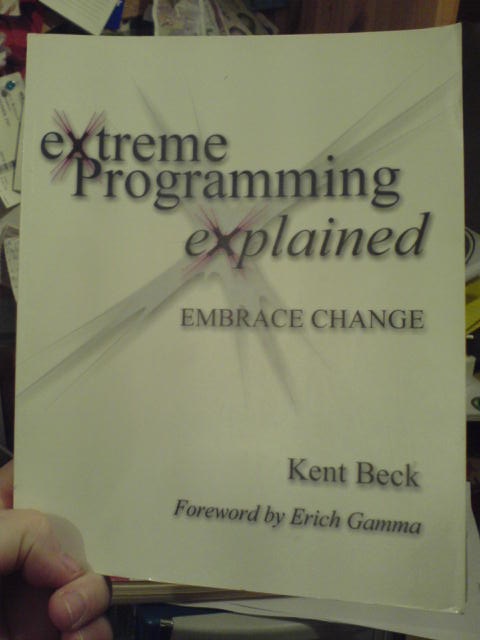
extreme Programming explained

is an excellent book by Kent Beck (isbn 0-201-61641-6). As usual I'm going to quote from a few pages:
Without courage, XP just simply doesn't work.
Communication supports courage because it opens the possibility for more high-risk, high-reward experiments… Simplicity supports courage because you can afford to be much more courageous with a simple system… Concrete feedback supports courage because you feel much safer trying radical surgery on the code if you can push a button and see tests turn green at the end (or not, in which case you can throw the code away).
Pair programming works for XP because it encourages communication… In my experience, pair programming is more productive than dividing the work between two programmers and then integrating the results.
If people program solo they are more likely to make mistakes, more likely to overdesign, and more likely to blow off the other practises, particularly under pressure.
There are times when problems simply can't be solved by the emergent brilliance of the team, encouraged by a loving and watchful manager. At times like this, the XP manager must be comfortable stepping in, making decisions - even unpopular ones - and seeing the consequences through to the end.
XP is a communal software development discipline.
The best environment is one of mutual trust.
Under stress, people revert to earlier behaviour, no matter how badly that behaviour has worked in the past.
Today's design should be done today and tomorrow's design should be done tomorrow.
Nerds aren't generally good at talking.
When you say one thing and do another, bad things happen. This book [Gerald Weinberg, Quality Software Management: Volume 4(sic), Congruent Action] talks about how to be congruent yourself, how to recognise incongruence in others, and what to do about it.

A day of deliberate practice

A Day of Deliberate Practice is the name of the JAOO conference tutorial session that Kevlin Henney and I are looking forward to running on Thursday 7th October. We've done some detailed preparation for it and think it's going to be really great. We will be using deliberate practice to try and increase the personal and technical agility of the participants.

You can get a 20% discount on the three conference days. Simply follow either Kevlin or myself on Twitter and then use “JAOOspeakerfollower” as promotion code upon registration: https://secure.trifork.com/aarhus-2010/registration/

The dance of life

is an excellent book by Edward T. Hall (isbn 0-385-19248-7). As usual I'm going to quote from a few pages:
All societies depend for the stability on feedback from the people. Depersonalization reduces feedback to a minimum, contributing to instability and lowering the overall level of congruence in the society.
Some things are not easily bent to simple linear description. Time is one of them.
Symbols should always be viewed as tools and consciously distinguished from the events which they symbolize.
Without environmental change, complex forms of life cannot evolve.
It is clear that our emphasis on saving time, which goes with quantifying time and treating it as a noun, would also lead to a high valuation of speed, which is demonstrated in much of our behaviour.
Nothing can grow in a healthy way unless it is in a time-controlled, uniform manner; for example, it is the unregulated (out-of-phase) growth of cells in the body that characterizes cancer.
"We have everything, but we don't have each other" [Takeo Matsuda]
The Pueblos believe that thoughts have a life of their own and that these live thoughts are an integral part of any man-made structure and will remain with that structure forever.
The more information that is shared... the higher the context.
As context is lost, information must be added if meaning is to remain constant.

Quality Software Management
Vol 3. Congruent Action

is an excellent book by Jerry Weinberg (isbn 0-932633-28-5). As usual I'm going to quote from a few pages:
Distrust any enterprise that requires new clothes. [Henry David Thoreau]
Incongruence is stereotyped behavior because it is not appropriate for the particular situation.
Busy management is bad management.
One of the functions of a leader is to become a focus for hostility.
Culture makes language, then language makes culture.
Breaking up economic teams is economic nonsense. Why is it so common?
In all Steering organizations the team is the fundamental unit of production.
In Steering organizations, managers rise above the level of product management and begin concentrating on process management.
We connect through our sameness and grow through our differences. [Virginia Satir]
Intellect is great, but character is more important.
Social skills influence more and more the effectiveness of technical skills.
We blame out of fear, and the blame creates a situation that justifies the fear.

What Did You Say?

is an excellent book (subtitled The Art of Giving and Receiving Feedback) by Charles and Edith Seashore and Jerry Weinberg (isbn 0-924771-33-X). As usual I'm going to quote from a few pages:
If you're not absolutely sure they want your feedback it's best not to offer it.
When the data and their model don't match, most people discard the data.
We structure our world so we will not receive feedback that threatens our view.
We don't even wait to ignore feedback, but actively take steps to prevent such feedback from ever happening in the first place.
We tend to learn only in new situations. In new contexts.
The more we try to control, the less influence we are likely to have.
Don't concentrate on giving feedback; concentrate on being congruent - responding to the other person, to yourself, and to the here-and-now situation.
The less investment you have in changing the other person, the greater the likelihood that each of you may grow.
Improving a relationship doesn't always mean making it closer.

The road less travelled and beyond

Is an excellent book by Scott Peck. As usual I'm going to quote from a few pages:
Community has to do with communication.
The word "diabolic" comes from the Greek diaballein, which means to throw apart or to separate, to compartmentalize. It is the opposite of "symbolic" which comes from the word symballein, meaning to throw together, to unify.
Virtually all truth is paradoxical.
Consciousness is inevitably associated with pain.
Perhaps the best measure of a person's greatness is the capacity for suffering.
The essence of this discipline of balancing is unlearning and "giving up" something in ourselves in order to consider new information.
Through the learning of emptiness, we experience a temporary state of consciousness in which the mind is utterly open and receptive and therefore totally alert.
There is no formula. All such decisions must be made out of the "agony of not knowing".
There is something far more important than inner peace: integrity. Integrity requires, among other things, the willingness to endure discomfort for the sake of truth.
One thing that never ceases to amaze me is how relatively few people understand what courage is. The absence of fear is not courage; the absence of fear is some kind of brain damage. Courage is the capacity to go ahead in spite of fear, or in spite of pain.
All discipline is a form of submission.
Speaking the truth - particularly when it requires some risk to do so - is an act of love.
The development of consciousness is thus, among other things, a process of the conscious mind opening itself to the unconscious in order to be congruent.
The unconscious is always one step ahead of the conscious mind.
The basic tenet of systems theory (which is actually not a theory but a fact) is that everything is a system.
Contingency theory (which, like systems theory, is not a theory but a fact) simply states that there is no one best type of organization.
Systems inherently resist change.

Systems Thinking

Human beings have evolved a very strong association that cause and effect are simple and linear; that cause and effect are local in space and local in time. We are not good at seeing the non-linear effects of our actions; the effects over distance and especially over time. Here's something a friend emailed me:

Last week I found that the guys had not checked in a big chunk of library code. It was in the place where common tool-chains were getting invoked, so no one noticed. They changed something and I was seeing sudden breakages even with older versions of the code which was working. They didn't even bother to put it into the version control. I just couldn't believe, people can work this way. I immediately put it into the svn.


Here's what I replied...

Why do you think they hadn't put it in svn? Because at some level they associate the pain of putting it into svn as being greater than the pain of not putting it into svn plus living in a messy kitchen! And who can blame them when helpful people like yourself come along and clean up their mess! They are probably hardly even consciously aware that have the option of putting it into svn themselves. If they haven't put it into svn for N weeks then that is the behaviour that has become their norm. And things that don't change are not seen or thought about. That's abstraction! You are part of the vicious cycle! You are helping to perpetuate their behaviour. You are part of the system!

A more congruent approach would have been to sit next to them and talk them through what they needed to do to tidy up the mess. You absolutely mustn't do any part of it for them. Only if they actually do it themselves will they have a chance of not repeating the situation. They have to type the keystrokes at the keyboard. Remember, it is trivial for you to do it, but for them it will mean working through some level of associated pain. That is not their "fault". They are simply, in this case, less experienced than you. You simply sit next to them and calmly, patiently, ever so patiently, talk them through it in a non threatening, non blaming way.