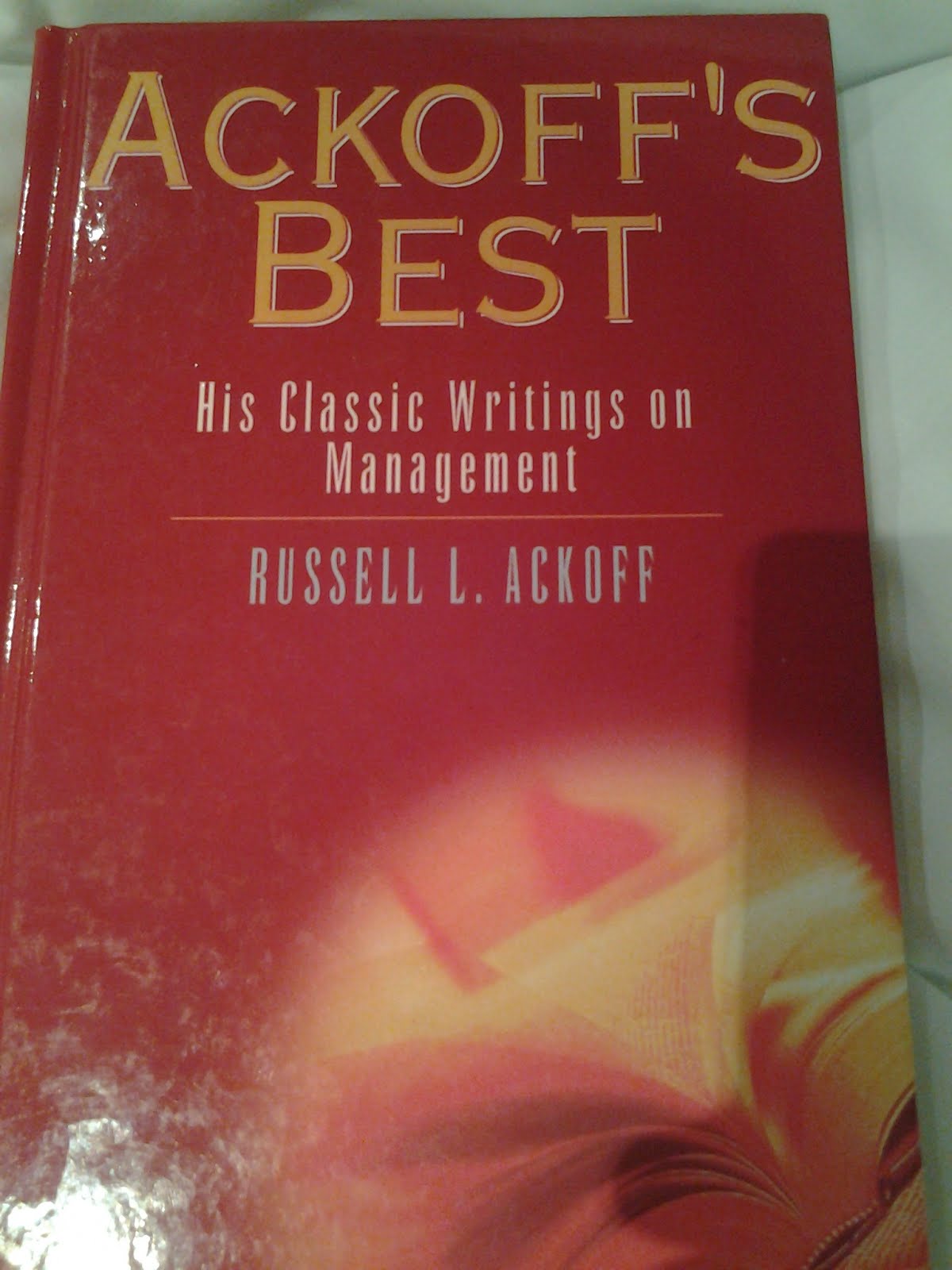
Ackoff's Best, by Russell Ackoff
is an excellent book by (isbn 978-0-471-31634-3).
As usual I'm going to quote from a few pages:
Analysis looks into things; synthesis looks out of things …
Analysis yields knowledge; synthesis yields understanding …
The former enables us to describe; the latter, to explain …
In analytic thinking, the thing to be explained is treated as a whole to be taken apart. In synthetic thinking the thing to be explained is treated as part of a containing whole. The former reduces the focus of the investigator; the latter expands it … Synthesis, or putting things together, is the key to systems thinking just as analysis, or taking them apart, was the key to Machine-Age thinking.
The essential properties of a system taken as a whole derive from the interactions of its parts, not their actions taken separately. Therefore, when a system is taken apart it loses its essential properties. Because of this - and this is the critical point - a system is a whole that cannot be understood by analysis.
Organisms and organisations are systems that usually have purposes of their own. However, the parts of an organism (i.e., hearts, lungs, brain) do not have purposes of their own, but the parts of an organisation do … An organisation with purposeful parts almost inevitably generates internal conflict … An organisation is a system whose major deficiencies arise from the ways its parts interact, not from their actions taken separately.
Automation is fundamentally different from mechanisation. Mechanization has to do with the replacement of muscle; automation with the replacement of mind.
The publicly owned company became a corporation (derived from "corpus", meaning "body") and the chief executive became the "head" of the firm.
Development of individuals and corporations is more a matter of learning than earning.
The most variety-decreasing type of social system is one we call a bureaucracy. A bureaucracy is an organisation whose principal objective is to keep people busy doing nothing. … The problem created by people who are busy doing nothing is that they frequently obstruct others who have real work to do. … Bureaucracies obstruct development. … Because bureaucracies tend to be inefficient and obstruct development they invite and encourage corruption.
If you're going to sin, sin against God, not the bureaucracy. God will forgive you but the bureaucracy won't. [Admiral Hyman G. Rickover]
Wisdom is the ability to see the long-run consequences of current actions, the willingness to sacrifice short-run gains for larger long-run benefits, and the ability to control what is controllable and not to fret over what is not … Even the best planning of which we are capable requires at least as much art as it does science … Planning is not an act but a process …
Today's students are over instructed in what they can better do alone: take things and concepts apart; and they are under instructed in what is very difficult to do alone: put what they have learned together into an understanding of the world and their role in it.
Effectiveness is evaluated efficiency. It is efficiency multiplied by value, efficiency for a valued outcome. Intelligence is the ability to increase efficiency; wisdom is the ability to increase effectiveness … Growth does not require an increase in value; development does.
Separation of the relevant information from the irrelevant is a critical part of problem formation … the reasons for wanting to answer a question determines what is the right answer to it.
A wrong solution to the right problem is generally better than the right solution to the wrong problem, because one usually gets feedback that enables one to correct wrong solutions, but not wrong problems. Wrong problems are perpetuated by right solutions to them.
Even those aspects of an organisation's future that are not affected by what it and others do (e.g. the weather) cannot be forecasted well for more than a short period. As in the case of the weather, however, the need to forecast it can be eliminated by bringing it under control, as we do by building structures within which work can proceed whatever the external weather may be.
 Is an excellent book by Bradford Keeney.
This is its first set of book snippets. Here's the
second.
As usual I'm going to quote from a few pages...
Is an excellent book by Bradford Keeney.
This is its first set of book snippets. Here's the
second.
As usual I'm going to quote from a few pages...